

The American Association of Orthodontists has published three pieces on artificial intelligence in recent months.
Each highlights the expanding role of AI beyond clinical treatment.
One is about being found in AI search. One is about keeping a practice's listings consistent. One is about disclosing when something was made with AI.
Ask most orthodontists what AI in orthodontics means and the answer lands somewhere clinical. Reading scans. Planning movement. That work is real. It is also not where the profession's own attention has been this autumn.
What those three pieces describe is the part that has already arrived. Not AI in the operatory. AI sitting between a person with a question and the practice they end up calling.
What the association is telling its members
The AAO reports that it appeared in 82 percent of AI answers to orthodontist-related questions, which it credits to work on what the marketing industry has started calling generative engine optimization. The figure is the association's own measurement, and the article does not publish the queries, the assistants or the dates behind it, so it is worth reading as a claim rather than a finding.
The advice attached to it is concrete enough to act on. Keep your Find an Orthodontist profile complete and current, because that is where an assistant sends someone who asks for an orthodontist near them.
The second piece makes the same point from the other direction. When a practice name, address and phone number disagree across a website, a Google Business Profile, Yelp and the AAO directory, those conflicting details "confuse users and crawlers alike". The remedy is an audit, with the practice website treated as the source of truth.
What Google itself says is required
Here is where it gets easier than it sounds, and this is the paragraph worth keeping.
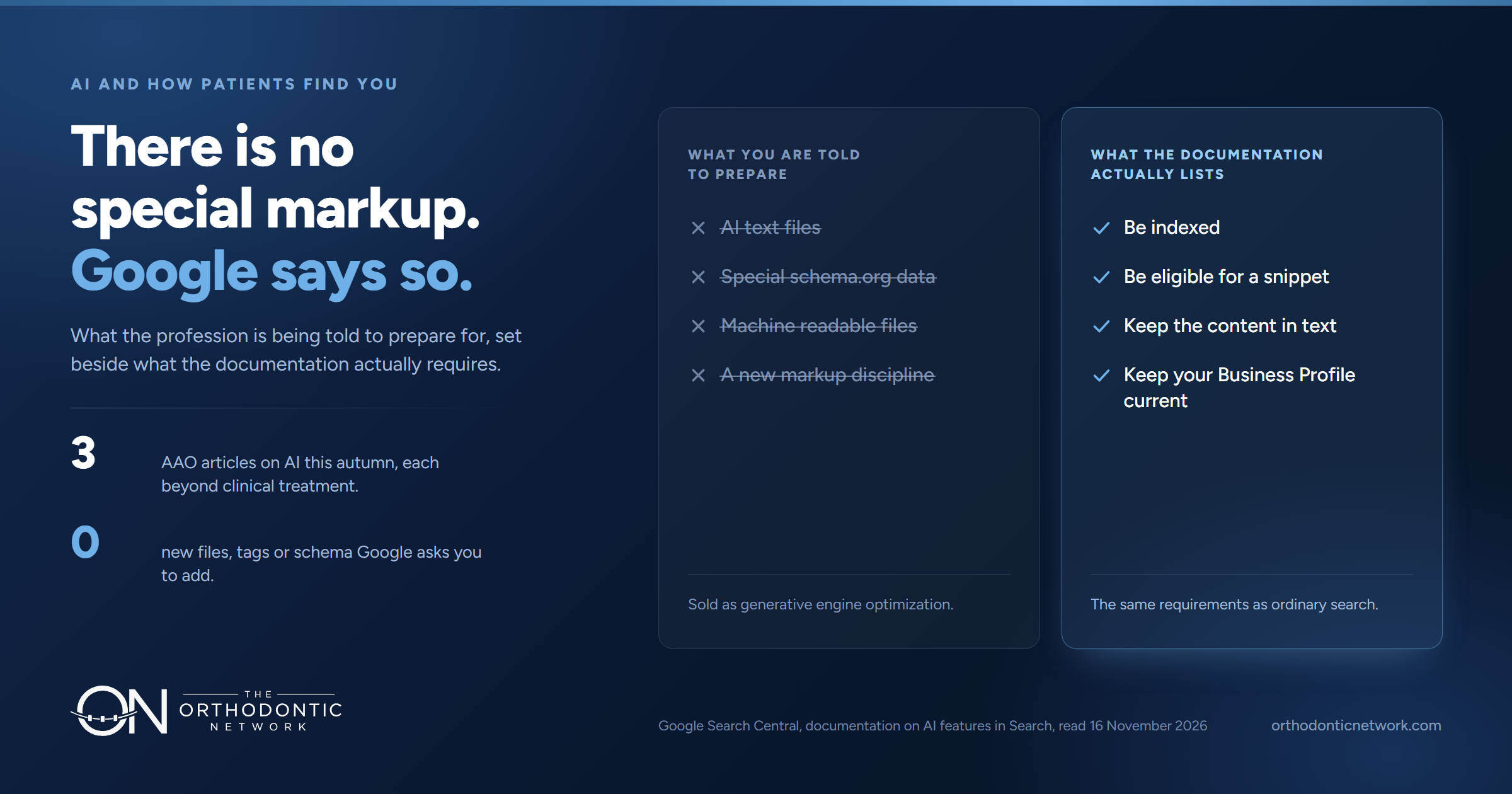
Google publishes its own documentation on AI features in Search. It states that for a page to be eligible to appear in AI Overviews and AI Mode, it needs to be indexed and eligible to be shown with a snippet. That is the requirement. Then it says this, in its own words:
You don't need to create new machine readable files, AI text files, or markup to appear in these features. There's also no special schema.org structured data that you need to add.
A profession currently being sold a new discipline deserves to read that sentence from the source.
The foundations Google lists are the same ones that have applied for years. Let the page be crawled. Link to it from somewhere. Keep the important content in text rather than locked inside an image. Make any structured data match what a reader actually sees. Keep your Business Profile information current.
There is no secret file. There is no tag that buys a mention.
The one mechanic that is genuinely worth an afternoon
If a practice does one thing after reading this, it should be the listing, because it is the single place where the association's advice and Google's own rules point at the same task.
Google's representation guidelines for a Business Profile require the business name as it is "consistently represented and recognized in the real world", with no taglines or marketing language bolted on. They require a precise address, not a PO box or an unstaffed virtual office. They require a phone number that connects to the individual location rather than a central call center, under the practice's own control.
The guidelines also set out what happens when the details are wrong. Google can change the information, or in some cases remove the business information entirely, and access to the profile can be suspended.
So the task is narrow. Open the practice website, the Google Business Profile, the AAO directory and whichever other listings exist. Write down the name, the address and the phone number from each. Make them identical, in the website's version. That is the whole job, and it is the version of this work with an actual mechanism behind it.
The half nobody is discussing yet
Being found is one problem. Being believed is the other, and it arrived on a date.
The AAO reports that since 2 August 2026 both Article 50 of the EU AI Act and California's AI Transparency Act have applied, and that the major AI companies began watermarking their output that month. A watermark, as the article describes it, is applied by the AI company to its own output and can be read only by that company. It adds nothing visible to the text.
For a practice, three places are exposed. Before and after photographs. Patient reviews and testimonials. Social advertising, where platforms increasingly apply their own labels.
The association's guidance here is the kind most orthodontists would arrive at anyway. Human clinical review before anything is published. Real practice details rather than generic drafts. Facts checked against published research.
These are legal texts and they deserve to be read directly rather than summarized twice, so treat the dates above as the association's account until you have seen the statutes themselves.
What a practice actually controls
Stripped to what the sources above support, the list is short.
Whether the website can be crawled and indexed. Whether the name, address and phone number say the same thing everywhere they appear. Whether the Google Business Profile and the AAO directory entry are current. Whether anything published under the practice's name has been through a person before it went out.
None of that is new work invented by artificial intelligence. It is the same housekeeping that has always decided whether a practice is easy to find, with a higher cost now for getting it wrong, because an assistant answering a question picks one practice and does not show the reader the other nine.
What it is not is a product anyone needs to sell you.
The Network was built for the conversations that follow a piece like this, the ones where a colleague says what actually happened in their own practice rather than what a vendor promised. So: what has genuinely changed this year in how your patients found you?