

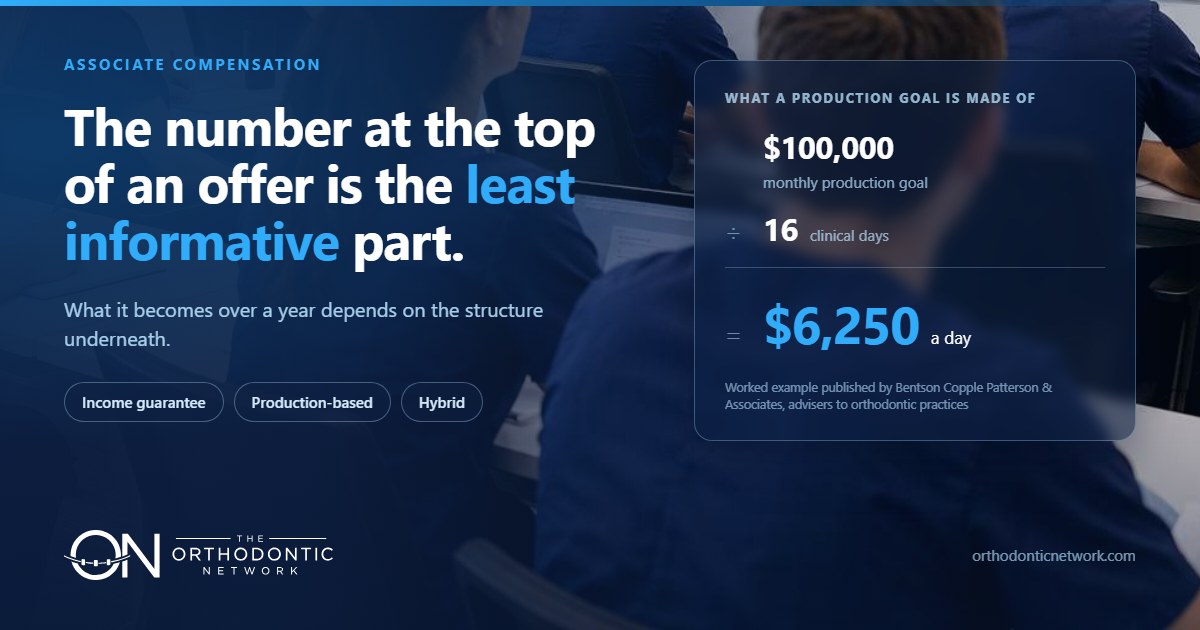
An offer arrives with a number at the top of it. That number is the least informative part of the page.
What it becomes over a year depends on the structure underneath: what is being counted, when it is counted, and who carries the shortfall when a schedule runs light. Two offers with the same headline figure can be thousands of dollars apart by December.
What follows is how the profession describes associate pay, and what the American Association of Orthodontists puts on the list of questions to ask before anything is signed.
Three shapes an offer takes
An advisory firm that works only with orthodontic practices sets out three models: an income guarantee, which is a fixed annual salary or per diem paid regardless of production; a production-based plan tied to the associate's clinical output and collections; and a hybrid, "a lower IG rate but a higher PBI plan", which the firm names as the most popular current approach.
The day is often the unit underneath all three. The same firm's worked example takes a $100,000 monthly production goal across 16 clinical days, which comes to $6,250 a day and roughly 1.2 starts a day.
The AAO's question list asks whether daily guarantees exist at all, and whether minimum day requirements come attached to them.
Adjusted production and collections are not the same word
Production is what was done. Collections are what arrived. In orthodontics the distance between the two runs months, because a case is paid across its length rather than on the day it starts.
Adjusted production is narrower again. Bentson Copple Patterson calculates it after discounts, write-offs and insurance, so the figure a percentage is applied to is smaller than the figure on the schedule.
The AAO's list puts the question plainly: whether compensation derives from adjusted production or from collections, and whether the associate can audit the calculation.
Most of the agreement is not about the pay
The AAO's questions to ask about an associateship, independent contract or dental service organization run well past the compensation clause.
On classification: "Does your position actually qualify for 1099 independent contractor status (very few do)?"
Then the term, auto-renewal and the notice a departure requires. Non-solicitation, and whether it reaches every office in a DSO. Exclusivity. Who carries malpractice insurance coverage, whether that carrier covers the associate at this job, and whether tail coverage will be needed afterward. Who owns the patient records, who stores them, and whether the associate can lock theirs. How a disagreement gets settled.
The same list notes that contracts are negotiable.
On non-competes, much of the common advice is out of date
A restrictive covenant stops an associate practicing nearby for a period after leaving. The AAO says most associate contracts carry one.
A good deal of what is written about them still describes a federal ban. There is not one. The Federal Trade Commission issued a rule in April 2024, a district court stopped it that August before it took effect, the Commission acceded to its vacatur in September 2025, and the rule was removed from the Code of Federal Regulations in February 2026.
Non-competes are governed by state law, and the states differ widely. On the contract as a whole, the AAO points to "a lawyer who is familiar with an orthodontic associate-type contract".
What sits behind a production number
A production-based plan is a bet on the practice as much as on the doctor. Bentson Copple Patterson weighs the practice's systems, its treatment coordinator, new patient consultation volume, conversion rate and marketing before a production plan is accepted.
The AAO adds the quieter questions: how much mentorship a candidate wants, whether they want to work alongside other orthodontists, and how far they are willing to commute. It also suggests talking the contract over with recent graduates, who signed one not long ago.
A first contract is a step rather than a destination
Few orthodontists start where they end up. The AAO's 2023 Economics of Orthodontics survey found that 71 percent of respondents under 35 were employees, and that 28 percent worked in a DSO or OSO setting, against 12 percent of those 35 and older.
Graduates also arrive carrying something. The average educational debt of indebted dental school graduates in the class of 2025 was $297,800, before a residency.
So a first contract is signed when a graduate has the least room to negotiate and the most to repay.
The wider picture, across associate positions, DSOs and ownership, is in our guide to what orthodontists earn in 2026.
What do you wish you had asked before you signed your first one?
The future of orthodontics is connected.